
McLeod County Court Records After Arrest
Court records after a jail arrest in McLeod County run through Minnesota's First Judicial District, McLeod County District Court, and the McLeod County Attorney. The jail roster may show an arrest charge, a status note, bail language, or a hold. That roster entry is not the final court charge record. The court record begins with the prosecutor's filed charge and then tracks hearings, court dates, bond orders, amendments, pleas, dismissal orders, sentencing, and public documents that are available under court rules.
McLeod County uses a county attorney, not a district attorney. Ryan Hansch is listed as County Attorney, and that office handles criminal actions tried on behalf of the State of Minnesota. For the custody side of the same event, use the jail inmate records page. For the photo side, use the jail mugshots page. The court records after an arrest should be read as the formal case path, not as a promise that every booking detail, booking photo, or law-enforcement report is posted in the court file.
Search McLeod County Court Records
The main statewide court portal is Minnesota Court Records Online, often called MCRO. It provides case search, document search, registers of actions, and public district court documents where online access is allowed. McLeod criminal case numbers commonly use the county number in the case format, so a court file found after a jail arrest may show a case number like a criminal division file rather than a jail booking number.
The MCRO access page limits online display to case records, hearing search results, monetary judgment data, registers of actions, judgment details, and public district court documents available under court rule. That means a search can show the formal court case after an arrest, but not every law-enforcement item. Investigative reports, nonpublic data, juvenile matters, sealed records, and some documents must be routed through the court, sheriff, attorney, or data-practices process that controls that record.
| Field Label | Type | Required | Notes |
|---|---|---|---|
| Person Name | Text | Depends on search type | Search by defendant first and last name. |
| Business Name | Text | Optional by search type | Used for organization parties, not typical jail-arrest searches. |
| Attorney Name | Text | Optional by search type | Can help when counsel is known. |
| Case Number | Text | Optional by search type | Use the court file number when it is known. |
| Citation Number | Text | Optional by search type | Useful for traffic or citation-based criminal matters. |
| Attorney Bar Number | Text | Optional by search type | Searches by attorney identifier. |
| Document Search Case Number | Text | Required for document search | Finds public online documents tied to a case number. |
The Minnesota Court Records Online page is the source shown here for statewide case search and document search options.
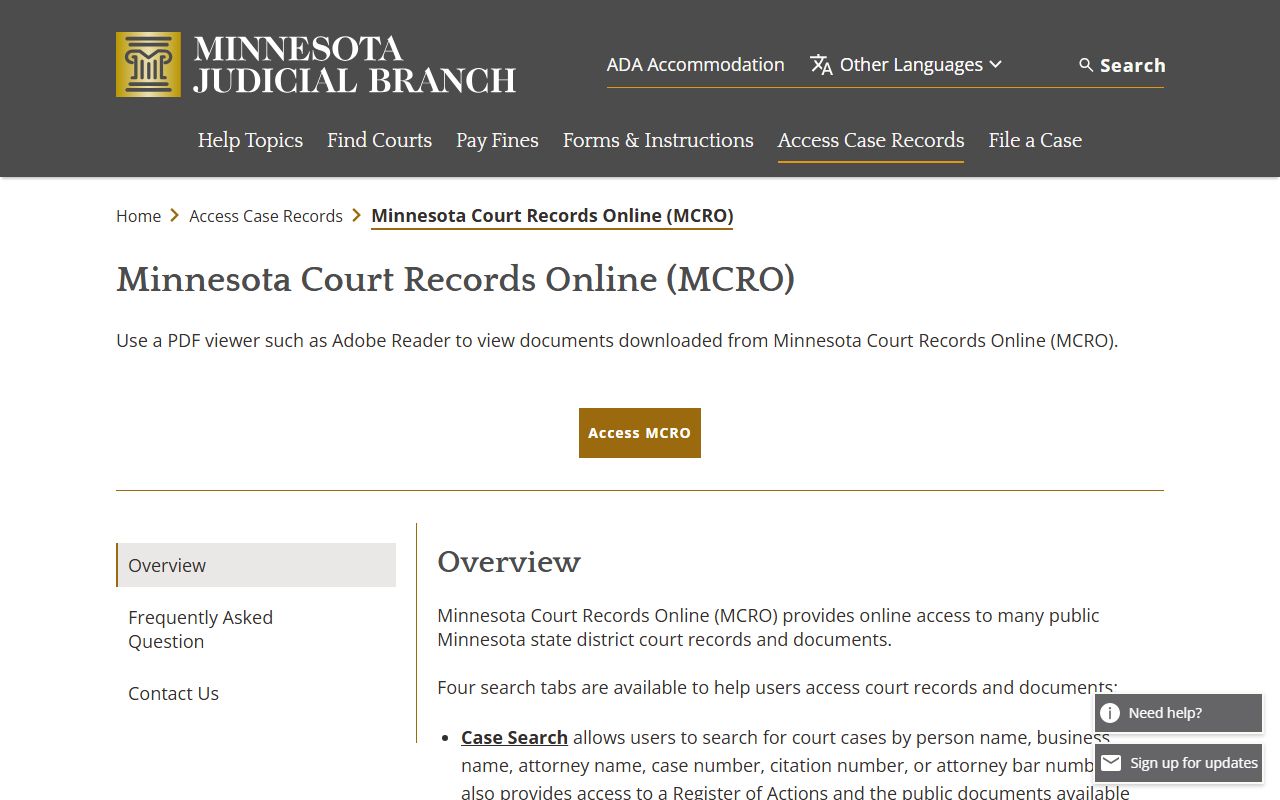
Use the court portal for case events and filed documents, then compare the result with the booking data if the person is still listed in local custody.
McLeod County Charging Records
McLeod County has a local charging-document path that matters after a jail arrest. The County Attorney Criminal Complaints page states that its database contains complaints for cases filed on or after January 1, 2025. Older complaints may be viewed at the McLeod County Courthouse. The same county page warns that filing a criminal charge is not evidence of guilt, and that defendants are presumed innocent unless and until proven guilty.
That complaint page is useful because it sits between the jail roster and the full court record. A jail booking can show the arrest charge and bail note. MCRO can show the court case and public documents. The County Attorney complaint database can help identify the formal charging document for newer McLeod County criminal cases. It does not replace District Court records for hearing dates, case history, or later filings.
| Document Type | Who Files It | What It Does | McLeod County Use |
|---|---|---|---|
| Complaint | Prosecutor, based on sworn facts | States the charged offense and probable-cause facts. | County Attorney database covers complaints filed on or after January 1, 2025. |
| Information | Prosecutor | Formal charging document used in some criminal procedures after the case has moved forward. | Look in MCRO or courthouse files if the case record lists one. |
| Indictment | Grand jury | Formal charge returned by a grand jury, usually for serious offenses. | Search the court case record and ask District Court if online documents are limited. |
The McLeod County Attorney Criminal Complaints page is the local source for newer complaint records.
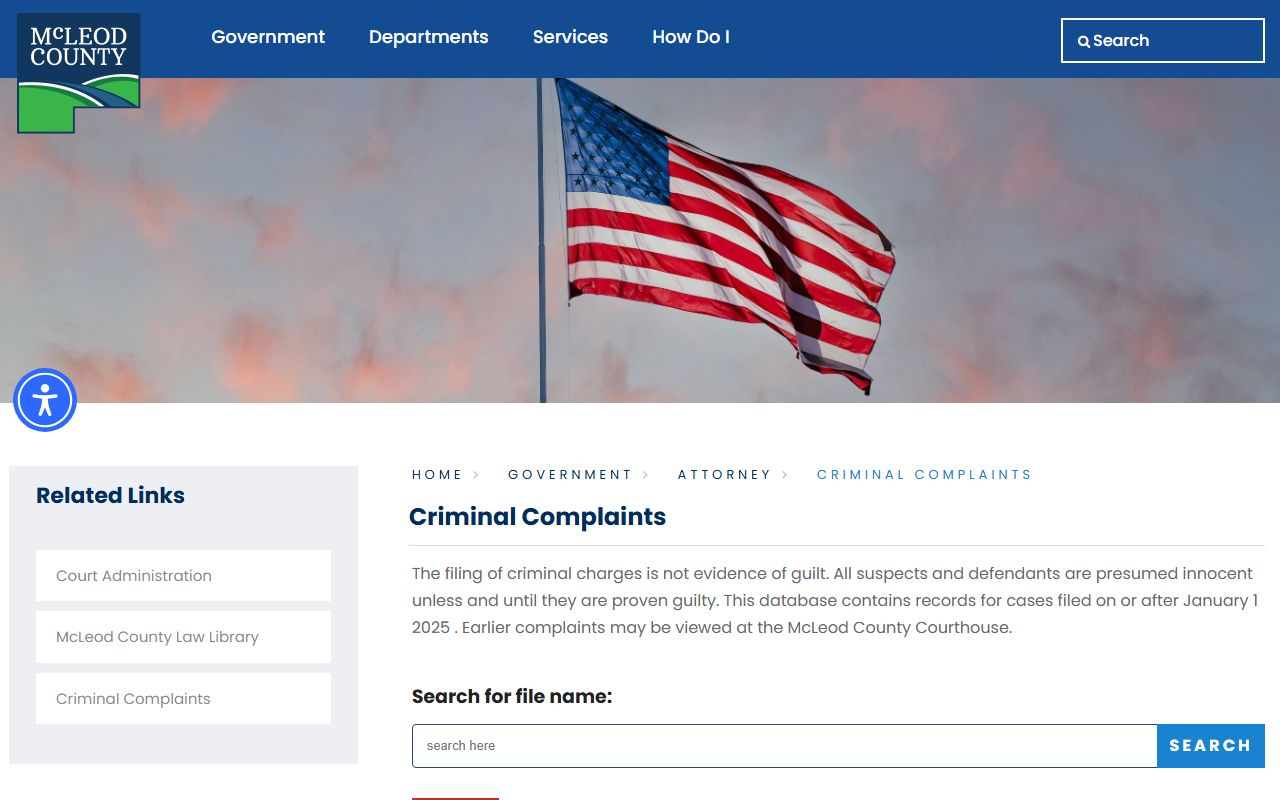
When the complaint is not in the online database, the courthouse route is part of the county's own access instructions.
Find Court Records After Arrest
A useful search starts with the date and charge shown by the jail, then moves to the county complaint source and MCRO. McLeod County's intake research says people in custody by 9:00 a.m. on a weekday are booked and paperwork is delivered to court administration for the daily jail calendar, subject to court circumstances. A person booked after that practical cutoff may not appear on the court calendar until the next scheduled court day.
- Check the current custody record for the booking name, intake date, booking number, arrest charge, and bail or hold note.
- Search the County Attorney complaint database for filed complaints on or after January 1, 2025.
- Search MCRO by person name, case number, or citation number for the district court record.
- Open the register of actions to compare the filed charge, hearing dates, bond orders, and court status.
- For older complaints or documents not online, contact McLeod County District Court at 320-864-1281 or inspect the courthouse file.
The courthouse and county offices are clustered in Glencoe, but each office has a different job. The County Attorney files and handles criminal charges for the State of Minnesota. District Court keeps the case record. The jail handles custody, booking, release, and local detention data. Mixing those roles is the most common cause of a failed search after a McLeod County arrest.
McLeod County Charge Status
Charge wording can shift between arrest, complaint, hearing, plea, and sentencing. The McLeod County custody list may show roster statuses such as Bond/Bail Set, Warrant, Court Order Hold, Sentenced, RPR'd, or Release to Another Authority. The court case may use different words because it tracks the filed case rather than the jail's custody reason. RPR means released on a promise to return. A court order hold means a judge or court process is controlling release.
| Status | What It Usually Means | Where to Confirm |
|---|---|---|
| Filed or Pending | A prosecutor has filed a charge and the case remains active. | MCRO register of actions and court file. |
| Amended or Reduced | The original count was changed, replaced, or lowered during the case. | Filed complaint, amended complaint, plea record, or order. |
| Dismissed | A count or case was ended by court action, prosecutor action, or other legal ruling. | Disposition entry and final order. |
| Sentenced | The case reached a sentence after plea, verdict, or other disposition. | Sentencing entry, warrant of commitment, and jail or DOC status. |
| Warrant or Hold | A warrant, court order, DOC warrant, or other-county hold may affect release. | Warrant list, jail, MCRO, issuing court, or dispatch. |
Note: A roster charge is a custody clue. The court file is the better source for the formal charge and case outcome.
Bond After McLeod County Arrest
The Bail and Warrant Information page says bail and bonds are accepted by Court Administration during weekday court hours, excluding legal holidays. After business hours, on weekends, and on holidays, Dispatch accepts bail and bonds. Before paying, call the jail or dispatch to confirm the current amount, accepted method, release conditions, and whether another hold blocks release.
McLeod roster entries can show cash or bond choices, conditional and unconditional amounts, bail received, bond received, and notes such as no-bail holds, domestic no-contact terms, testing, GPS, DOC warrant language, or another county's warrant. A listed dollar amount does not always mean the person can walk out once money is posted. A detainer is a hold or notice from another authority. A remand means the court has ordered custody.
| Release Item | Local Meaning | Practical Check |
|---|---|---|
| Cash Bail | Money paid to secure release. | Confirm amount with court, jail, or dispatch before payment. |
| Bond | Security posted through the accepted bond process. | Ask whether bond is accepted for the specific charge or warrant. |
| Conditional Amount | Lower amount may require DANCO, testing, GPS, or other terms. | Read the court order and roster note together. |
| Unconditional Amount | Higher amount may be listed without added conditions. | Confirm that no other hold remains. |
| Hold Without Bail | Payment alone does not authorize release. | Contact the court or agency that issued the hold. |
Warrants and Court Records
A warrant can lead to arrest, jail booking, and a new or reopened court record. McLeod County's Warrant Search page links to an active warrant list, and the jail intake page tells people to call Dispatch at 320-864-3134 for warrant questions. The county also notes that newly issued court warrants can take several days to enter the warrant system, so a missing name on the warrant list is not final proof that no warrant exists.
For a warrant arrest, compare three sources: the warrant list or dispatch phone channel, the jail roster, and MCRO. The roster may show a status of Warrant or Court Order Hold. MCRO may show the underlying case, hearing history, bench warrant event, or bond order. If the warrant belongs to another county or a DOC matter, McLeod County may only show the local hold while the issuing authority controls the next step.
Charges, Convictions, and Expungement
A charge is not a conviction. McLeod County's own complaint page says criminal charges are not evidence of guilt and defendants are presumed innocent unless and until proven guilty. That statement matters for anyone reading court records after an arrest. A filed complaint may be amended, dismissed, or resolved by plea or verdict. For record-cleanup questions, Minnesota's expungement chapter is the starting point, but eligibility depends on the case type and outcome.
| Comparison | Charge | Conviction |
|---|---|---|
| Case stage | An accusation filed in court. | A final finding after plea, verdict, or adjudication. |
| Meaning | Not proof of guilt. | Formal legal outcome on the count. |
| Where seen | Complaint, register of actions, hearing entries. | Disposition, sentencing entry, judgment, or order. |
| Comparison | Sealed | Expunged |
|---|---|---|
| Public access | Hidden from general public access when a court order applies. | Sealed through Minnesota expungement procedures when granted. |
| Legal source | Court order or data classification controls access. | Minn. Stat. Ch. 609A. |
| Limits | Some agencies may retain access under law. | Does not erase every copy held outside the court system. |
McLeod County Public Access Rules
Minnesota public access rules split records by record holder and classification. Minn. Stat. 13.03 is the general public government data rule. Minn. Stat. 13.82 covers law-enforcement data, including arrest and investigative data. Minn. Stat. 13.85 covers corrections and detention data, which is why the county can publish public booking information. Court records then follow Minnesota court access rules and MCRO limits.
If the online court record does not answer the question, use the office that controls the record. McLeod County District Court handles court files and older complaint access at the courthouse. The Sheriff's Office records request path handles jail and law-enforcement public data. The County Attorney handles its own complaint database and criminal prosecution records. For people sentenced to state prison, the Minnesota Department of Corrections locator is separate from the county court and jail systems.
Important: This private site is not a consumer reporting agency and cannot be used for FCRA-covered decisions.